Timescape by Gregory Benford
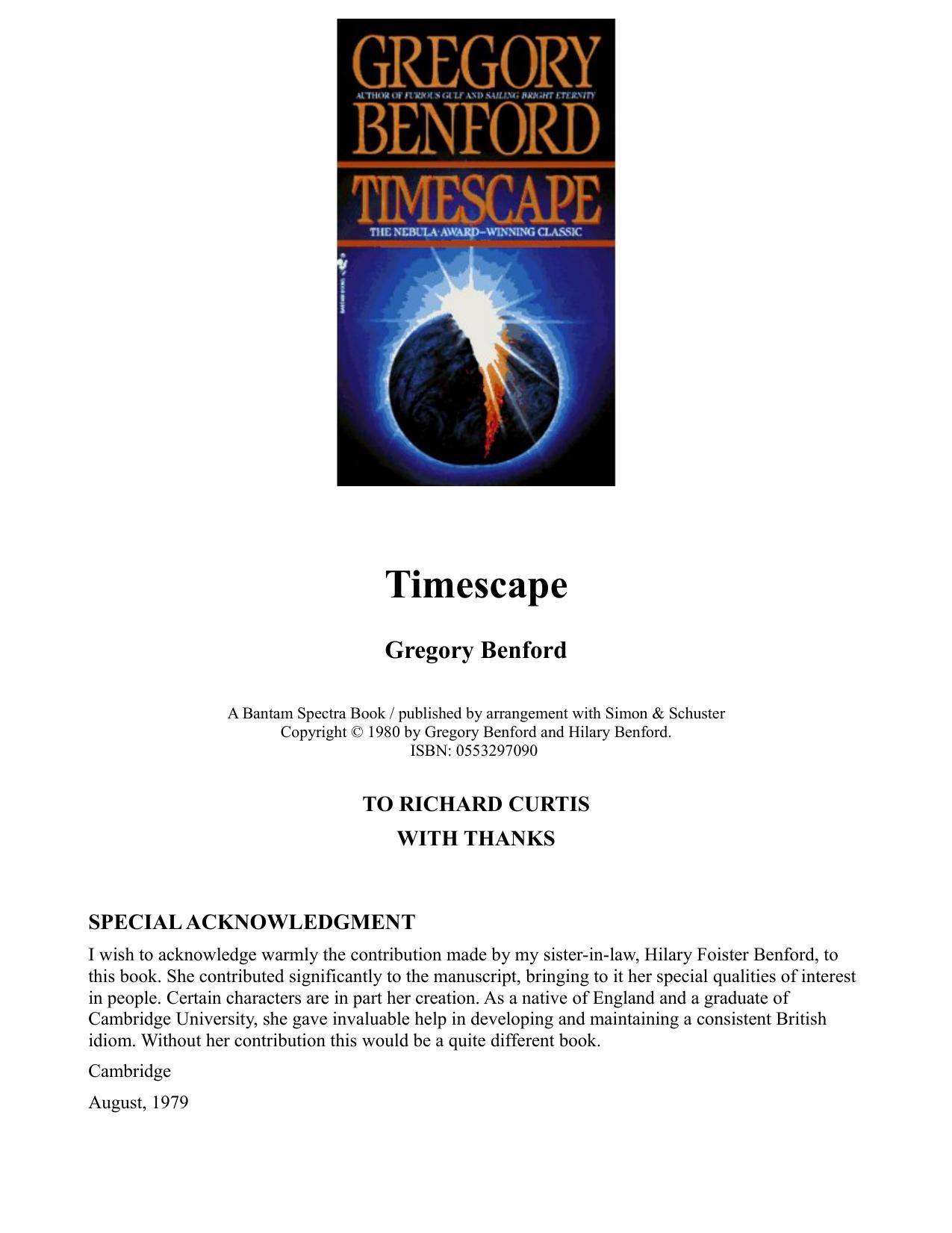
Author:Gregory Benford [Benford, Gregory]
Language: eng
Format: epub, mobi, azw3, pdf
Tags: Science Fiction, Fiction, General, Time Travel
ISBN: 9780553297096
Publisher: Spectra
Published: 0101-01-01T00:00:00+00:00
CHAPTER EIGHTEEN
MAY 24, 1963
THE SAN DIEGO AREA WAS GROWING AND SPREADING. Rather than pattern itself on the jumble of Los Angeles, the younger city to the south chose to encourage white-collar employers, “clean” industries, and think tanks. The largest such tank in the area was General Atomic, scarcely a mile from the fledgling University. Quite considerable fish were to be seen swimming in its waters, puzzling at government-sponsored problems. Noted names from Berkeley and Caltech spent pleasant months scribbling on blackboards while outside, the General Atomic squirrels and rabbits lazily foraged for their handouts. The animals were part of a psychologist’s deliberate plan to evoke rest, quiet, and deep thought; the resemblance to a Disney film may have been accidental. The architect’s remorselessly circular motif for the central General Atomic offices, with the eagerly cooperative library at its center, had a similar aim. The ringed roads and buildings recalled Oriental notions of completeness, of serenity, of rest. The curved hallways would increase contact between researchers. In fact, though, the inescapable geometry meant that no one could see further than thirty feet along the curving corridors. This tended to prevent the accidental meetings as scientists came and went; they passed out of view before they could be noticed. To go home or to the library meant moving radially, and thus seeing nobody. As Freeman Dyson said that summer, “The mean interaction distance around here is no bigger than a soccer goal.” Yet often it was enough; these were exciting times. Only six months before, Mariner II had surveyed Venus close up for the first time. Gell-Mann and others were plumbing new depths in particle theory. In April, J. Robert Oppenheimer was named winner of the Atomic Energy Commission’s 1963 Fermi award. Oppenheimer had been, in the eyes of many scientists, the public whipping boy of the McCarthy era; he had been declared a security risk in 1954. Now at last the government seemed to be serving some penance for its stupidity. Hard feelings against Edward Teller, who had not spoken out strongly for Oppenheimer, in turn began to wane.
The feeling of opening, of fresh starts, was on the political scene already a cliché. The Kennedy ambience was a canon of media hype. Vaughn Meader’s “The First Family” album, which mocked the Kennedy clan, sold briskly; the public sensed that the derision was all in good fun. Scientists were a more skeptical lot, however, mostly liberal or radical, and bothered by Bobby Kennedy’s generally perceived ruthlessness and neglect of the legal niceties of wiretapping. But the rise of support for scientific research was now coming to seem like a permanent feature, beginning with a sudden rush after Sputnik and rising linearly. Everyone knew it would plateau out, but not soon; there was much to be done, and few to do it.
Freeman Dyson came to California on leave from Princeton’s Institute for Advanced Study, to work on the Orion project. Dyson had an immense reputation as a theoretical physicist and thus was invited to give one of the last spring Colloquia in the UCLJ Physics Department.
Download
Timescape by Gregory Benford.epub
Timescape by Gregory Benford.mobi
Timescape by Gregory Benford.azw3
Timescape by Gregory Benford.pdf
This site does not store any files on its server. We only index and link to content provided by other sites. Please contact the content providers to delete copyright contents if any and email us, we'll remove relevant links or contents immediately.
| Fantasy | Gaming |
| Science Fiction | Writing |
Sita - Warrior of Mithila (Book 2 of the Ram Chandra Series) by Amish(55281)
The Crystal Crypt by Dick Philip K(37049)
Cat's cradle by Kurt Vonnegut(15552)
Ready Player One by Cline Ernest(15139)
Always and Forever, Lara Jean by Jenny Han(15067)
The Last by Hanna Jameson(10378)
Year One by Nora Roberts(9953)
Persepolis Rising by James S. A. Corey(9564)
The remains of the day by Kazuo Ishiguro(9218)
Never let me go by Kazuo Ishiguro(9098)
Red Rising by Pierce Brown(8988)
Dark Space: The Second Trilogy (Books 4-6) (Dark Space Trilogies Book 2) by Jasper T. Scott(8327)
The handmaid's tale by Margaret Atwood(7904)
Frank Herbert's Dune Saga Collection: Books 1 - 6 by Frank Herbert(7342)
The Circle by Dave Eggers(7250)
The Testaments by Margaret Atwood(7092)
Legacy by Ellery Kane(6768)
Pandemic (The Extinction Files Book 1) by A.G. Riddle(6668)
Six Wakes by Mur Lafferty(6405)
